
Delving into the realm of Saving Bonds vs CDs (Certificates of Deposit), this exploration promises to shed light on the nuances of these financial instruments, offering a comprehensive view that is both informative and intriguing.
As we navigate through the intricacies of savings bonds and CDs, we will uncover key differences, risk factors, and interest rates associated with each option.
Savings Account
A savings account is a type of deposit account held at a bank or financial institution that allows you to securely store your money while earning interest on your balance.
Benefits of Having a Savings Account
- Security: Savings accounts are typically FDIC insured, providing a safe place to keep your money.
- Interest Earnings: Unlike checking accounts, savings accounts offer interest on your balance, helping your money grow over time.
- Liquidity: Savings accounts provide easy access to your funds, allowing you to withdraw money when needed without facing penalties or restrictions.
- Goal Setting: Savings accounts are great for setting aside money for specific goals, such as emergencies, vacations, or major purchases.
Comparison of Liquidity
When it comes to liquidity, savings accounts offer high flexibility compared to other investment options like certificates of deposit (CDs) or bonds. Unlike CDs that have fixed terms and early withdrawal penalties, savings accounts allow you to access your funds whenever you need them without facing restrictions or penalties.
Savings Bonds vs CDs (Certificates of Deposit)
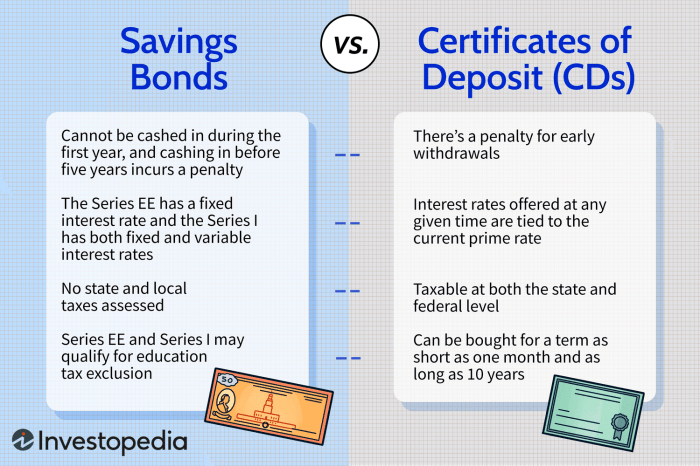
Savings bonds and Certificates of Deposit (CDs) are both types of investments that offer fixed returns over a specific period. However, there are key differences between the two options.
Differentiation
- Savings Bonds: Savings bonds are issued by the government and are considered a low-risk investment. They are backed by the government, making them a safe option for investors. Savings bonds typically have a fixed interest rate and maturity date.
- Certificates of Deposit (CDs): CDs are offered by banks and credit unions. They also provide a fixed interest rate but are not backed by the government. CDs have a specific term length, ranging from a few months to several years, during which the funds must remain untouched to earn the promised interest.
Risk Levels
- Savings Bonds: Savings bonds are considered low-risk investments due to the government backing. Investors are guaranteed to receive the principal amount invested plus interest upon maturity.
- Certificates of Deposit (CDs): CDs are also relatively low-risk investments, especially when obtained from FDIC-insured institutions. However, there is a risk of early withdrawal penalties if funds are accessed before the CD matures.
Interest Rates
- Savings Bonds: The interest rates offered by savings bonds are usually lower compared to other investment options. However, they are considered safe and reliable for conservative investors.
- Certificates of Deposit (CDs): CDs typically offer higher interest rates than savings accounts but may have lower rates than other investment vehicles. The longer the term of the CD, the higher the interest rate tends to be.
Savings Bonds
Savings bonds are a type of investment issued by the government to individuals as a way to borrow money from them. When you purchase a savings bond, you are essentially lending money to the government, which will pay you back with interest over a specified period.
Types of Savings Bonds
- Series EE Bonds: These bonds are purchased at face value and accrue interest for up to 30 years. They are low-risk investments and are guaranteed by the US government.
- Series I Bonds: These bonds are inflation-protected, meaning they adjust with inflation rates. They also earn interest for up to 30 years and are considered a safe investment option.
Advantages and Disadvantages of Investing in Savings Bonds
- Advantages:
- Low Risk: Savings bonds are backed by the government, making them a low-risk investment option.
- Guaranteed Returns: You are guaranteed a return on your investment when the bond matures.
- Tax Benefits: Interest earned on savings bonds is exempt from state and local taxes, and federal taxes can be deferred until the bond is cashed.
- Disadvantages:
- Low Returns: Compared to other investment options, savings bonds offer relatively low returns.
- Long Maturity Period: Savings bonds have a long maturity period, which may not be ideal for those looking for quick returns on their investment.
- Interest Rate Risk: Since the interest rates on savings bonds are fixed, there is a risk of losing out on potential higher returns if market interest rates rise.
CDs (Certificates of Deposit)
Certificates of Deposit (CDs) are a type of savings account that typically offer higher interest rates than regular savings accounts. They are time deposits with fixed terms and usually have penalties for withdrawing funds before the maturity date.
Overview of CDs
- CDs function as a way for individuals to earn higher interest on their savings by depositing a specific amount of money for a set period of time.
- They are issued by banks and credit unions and are considered low-risk investments.
- Interest rates for CDs are determined by the market and the length of the term chosen by the depositor.
Maturity Periods of CDs
- Common maturity periods for CDs range from a few months to several years.
- Short-term CDs typically have terms of 1 month to 1 year, while long-term CDs can have terms of 5 years or more.
- The longer the term of the CD, the higher the interest rate generally offered.
Accrual of Interest on CDs
- Interest on CDs is typically accrued daily or monthly, depending on the financial institution.
- Some CDs allow for the interest to be withdrawn periodically, while others may require the interest to remain in the account until the maturity date.
- Interest can be compounded, meaning it is added back to the principal balance, leading to higher overall returns.
In conclusion, the comparison between Saving Bonds and CDs reveals a spectrum of choices for investors, each with its own set of advantages and drawbacks. Whether opting for stability or seeking higher returns, understanding these investment vehicles is crucial for making sound financial decisions.
Quick FAQs
What is the main difference between savings bonds and CDs?
Savings bonds are issued by the government, while CDs are typically offered by banks or credit unions.
Which option usually offers higher interest rates, savings bonds, or CDs?
Generally, savings bonds tend to offer slightly higher interest rates compared to CDs.
Are savings bonds or CDs more liquid in terms of accessing funds?
CDs usually have penalties for early withdrawal, making savings bonds relatively more liquid in terms of accessing funds.


